
6 min read
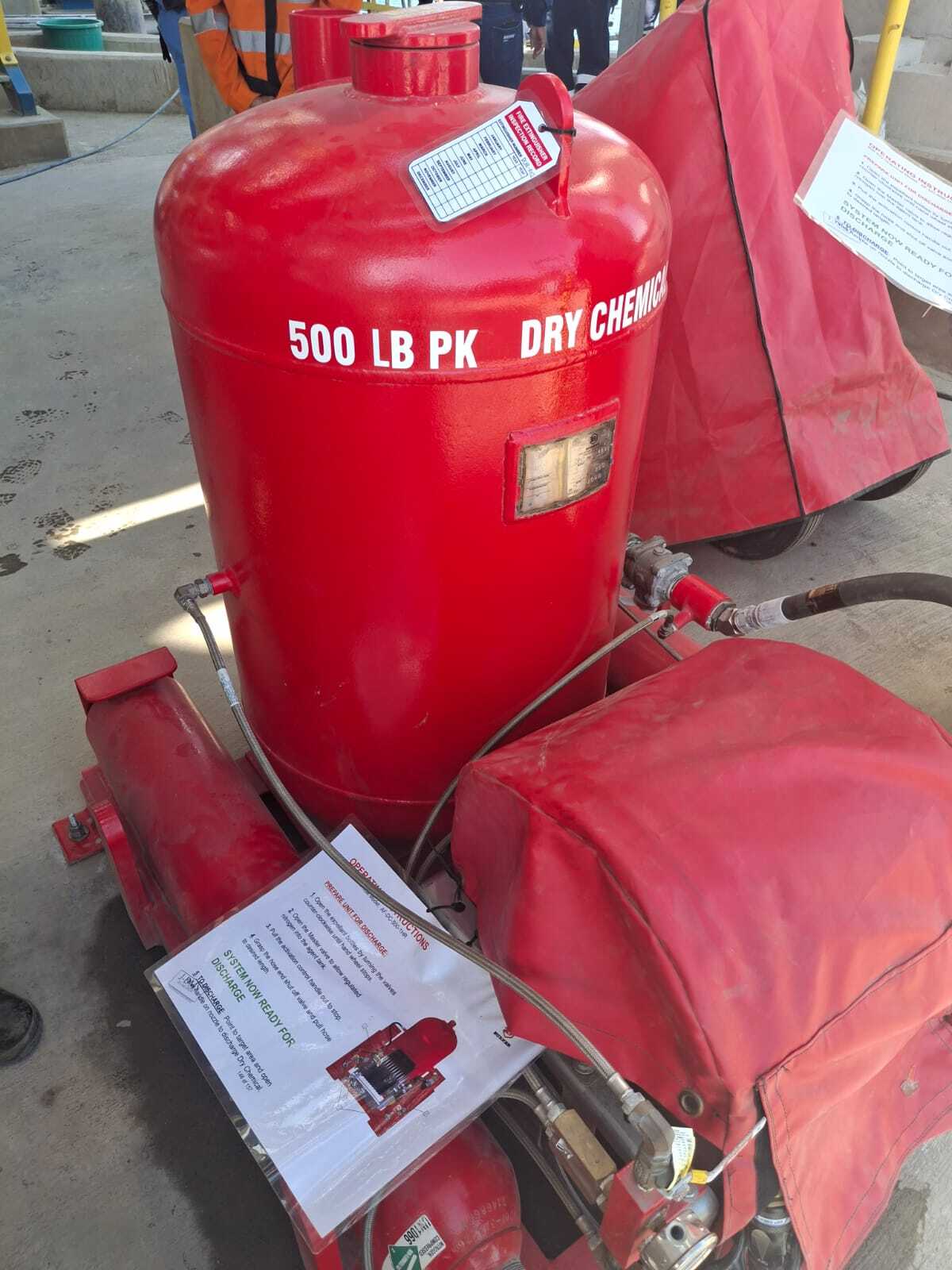
Dry Chemical fire protection is crucial for LNG bunkering Hazards due to its rapid knockdown of flammable gas fires
And effectiveness in marine environments where water isn't always ideal, protecting assets and personnel at high-risk fueling points by interrupting the fire's chemical reaction and preventing re-ignition (unlike water which can spread LNG).
LNG Vessels & Facilities are highly regulated and much guidance is given through governing organizations like ABS (American Bureau of Shipping) and IMO (International Maritime Organization). ABS Rule 5C-8 (Part 5C, Chapter 8) of the American Bureau of Shipping (ABS) Rules for Building and Classing Steel Vessels (Marine Vessel Rules) details requirements for fire-extinguishing systems on specific vessel types, particularly those carrying hazardous cargoes like LNG, mandating dry chemical powder systems for vulnerable areas like bunker manifolds and cargo machinery spaces, often with specific delivery methods (hand hoses/monitors) and integration with ventilation systems, aligning with IMO codes. The following are a few references to this guidance:
ABS GUIDE FOR ENHANCED FIRE PROTECTION ARRANGEMENTS 2022
5. Dry Chemical Powder Fire-Extinguishing System
5.1 General In addition to the requirements of 5C-8-11/4 of the Marine Vessel Rules, dry chemical powder fire extinguishing systems are to comply with the following additional requirements.
5.3 Capacity A sufficient quantity of dry chemical powder is to be stored in each container to provide a minimum sixty (60) second discharge time when all attached hand hose lines and monitors are operated simultaneously.
5.5 Pressure Gas and Piping Industrial grade nitrogen with a dew point of –50°C (–58°F) or lower is to be used as the expellant gas (i.e., pressure gas) to discharge the dry chemical powder. Pressure gas piping is to be regarded as class I piping. However, the main powder piping can be classified as class III piping (see 4-6-1/5 of the Marine Vessel Rules for “class” of piping).
5.7 Materials The powder distribution lines and the pressure gas lines are to be constructed of type 316 stainless steel or equivalent corrosion-resistant materials having melting points of at least 925°C (1700°F).
5.9 Distance of Fixed Piping between the Powder Container and the Monitors The distance of fixed piping between the powder container and the monitors is to be limited to 10 meters (33 feet). However, longer distances may be considered provided full-scale testing has documented that the length of piping: i) Is capable of maintaining the powder in a fluidized state during both sustained and intermittent use, ii) Can be purged of powder when the system is shut down, and iii) Has means to avoid free water in the line.
5.11 Dry Chemical Powder Hose Station Each dry chemical powder hose station is to consist of: i) One (1) dry powder hose line with trigger nozzle, and ii) One (1) nitrogen gas container for pneumatic release of the system. The above equipment is to be stored in boxes that are: i) Clearly marked, ii) Made of corrosion-resistant materials and, iii) Provided with instructions for operation of the system.
ABS GUIDE FOR LNG REGASIFICATION VESSELS
17.3 Dry Chemical Powder Fire-extinguishing Systems
Dry chemical powder fire-extinguishing systems are to be provided as required by 5C-8-11/4 of the Marine Vessel Rules. The system is to be capable of delivering powder from at least two hand hose lines or a combination of monitor/hand hose lines, to any part of the exposed cargo liquid and vapor piping, load/unload connection and exposed gas process units.
ABS GUIDE FOR LNG BUNKERING - JANUARY 2017 (Updated March 2018)
7.13 Fire Extinguishing Systems
i) A water spray system in accordance with 5C-8-11/3 of the Steel Vessel Rules is to be provided for each bunker manifold area.
ii) A dry chemical powder fire extinguishing system in accordance with 5C-8-11/4 of the Steel Vessel Rules is to be provided for each bunker manifold area.
ABS RULES FOR BUILDING AND CLASSING STEEL VESSELS - 2010
4. Dry chemical powder fire-extinguishing systems
4.1 Ships in which the carriage of flammable products is intended should be fitted with fixed dry chemical powder type extinguishing systems for the purpose of fighting fire on the deck in the cargo area and bow or stern cargo handling areas if applicable. The system and the dry chemical powder should be adequate for this purpose and satisfactory to the Administration.
4.2 The system should be capable of delivering powder from at least two hand hose lines or combination monitor/hand hose lines to any part of the above-deck exposed cargo area including above-deck product piping. The system should be activated by an inert gas such as nitrogen, used exclusively for this purpose and stored in pressure vessels adjacent to the powder containers.
4.3 The system for use in the cargo area should consist of at least two independent self-contained dry chemical powder units with associated controls, pressurizing medium fixed piping, monitors or hand hose lines. For ships with a cargo capacity of less than 1,000 m3 only one such unit need be fitted, subject to approval by the Administration. A monitor should be provided and so arranged as to protect the cargo loading and discharge manifold areas and be capable of actuation and discharge locally and remotely. The monitor is not required to be remotely aimed if it can deliver the necessary powder to all required areas of coverage from a single position. All hand hose lines and monitors should be capable of actuation at the hose storage reel or monitor. At least one hand hose line or monitor should be situated at the after end of the cargo area.
4.4 A fire-extinguishing unit having two or more monitors, hand hose lines, or combinations thereof, should have independent pipes with a manifold at the powder container, unless a suitable alternative means is provided to ensure proper performance as approved by the Administration. Where two or more pipes are attached to a unit the arrangement should be such that any or all of the monitors and hand hose lines should be capable of simultaneous or sequential operation at their rated capacities.
4.5 The capacity of a monitor should be not less than 10 kg/s. Hand hose lines should be non-kinkable and be fitted with a nozzle capable of on/off operation and discharge at a rate not less than 3.5 kg/s. The maximum discharge rate should be such as to allow operation by one man. The length of a hand hose line should not exceed 33 m. Where fixed piping is provided between the powder container and a hand hose line or monitor, the length of piping should not exceed that length which is capable of maintaining the powder in a fluidized state during sustained or intermittent use, and which can be purged of powder when the system is shut down. Hand hose lines and nozzles should be of weather-resistant construction or stored in weather-resistant housing or covers and be readily accessible.
4.6 A sufficient quantity of dry chemical powder should be stored in each container to provide a minimum 45 seconds discharge time for all monitors and hand hose lines attached to each powder unit. Coverage from fixed monitors should be in accordance with the following requirements: See 4.6 Table
Hand hose lines should be considered to have a maximum effective distance of coverage equal to the length of hose. Special consideration should be given where areas to be protected are substantially higher than the monitor or hand hose reel locations.
4.7 Ships fitted with bow or stern loading and discharge arrangements should be provided with an additional dry chemical powder unit complete with at least one monitor and one hand hose line complying with the requirements of 5C-8-11/4.1 to 5C-8-11/4.6. This additional unit should be located to protect the bow or stern loading and discharge arrangements. The area of the cargo line forward or aft of the cargo area should be protected by hand hose lines.
NFPA
NFPA 59A is the standard for Liquefied Natural Gas (LNG) facilities, covering fire protection, design, and operation, and it references other NFPA codes for specific equipment, including dry chemical systems for fast Class B/C fire suppression, often required in high-flow units for gas fires and suitable for outdoor LNG scenarios. Dry chemical systems are vital for LNG facilities, providing fast extinguishment for flammable gas fires and pressurized gas hazards, as detailed in related NFPA documents.

Related Posts
FDIC Fire Show attracts the latest in Fire Protection
Burner exhibits Fire Protection line at FDIC Fire Show in Indianapolis
Potassium Bicarbonate Powder (Purple-K)
United States Naval Research Laboratory
In 1959, a series of original investigations by NRL in the...
Twin Agent Fire-Fighting Skids: The solution for multiple hazards in extreme environments
Twin-Agent Fire-Fighting Skids are self-contained, mobile fire suppression systems that combines...